


Permitted Development rules





Professional, builder-ready drawing packages for extensions, lofts, porches, garages, garden rooms and more — designed to Permitted Development parameters and supplied as sold.
PERMITTED HOMEOWNER GUIDES
Our illustrated, practical guides help you understand the rules, explore design options and budget with confidence — before you commit to building work.
Explore all guides
Rules, design options, costs and next steps.
View guide
Rules, design options, costs and next steps.
View guide
Rules, design options, costs and next steps.
View guide
Rules, design options, costs and next steps.
View guide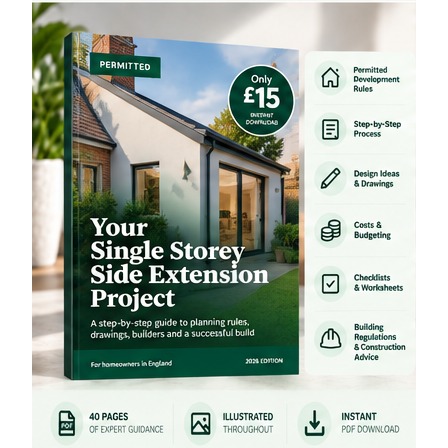
Rules, design options, costs and next steps.
View guide
Rules, design options, costs and next steps.
View guide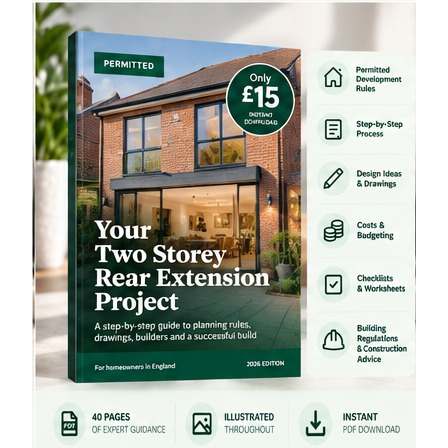
Rules, design options, costs and next steps.
View guide
Rules, design options, costs and next steps.
View guideThe Party Wall etc. Act 1996 gives you the right to carry out certain building works — but it also requires you to notify your neighbours first. Here’s everything homeowners need to know about when it applies, notice periods, and what happens if your neighbour objects.
The Party Wall etc. Act 1996 is a piece of legislation that governs building work on or near shared walls and boundaries in England and Wales. It was introduced to prevent disputes between neighbours by creating a formal notification process before work begins.
The Act applies to:
The Party Wall Act is separate from planning permission and permitted development rights. Even if your project doesn’t need planning permission, it may still trigger Party Wall Act obligations.
The Act applies whenever you intend to carry out work that falls into one of three categories set out in the legislation. It covers homeowners, landlords, and tenants — essentially anyone who wants to do notifiable building work.
Typical projects that trigger the Act include:
The Act does not apply to minor works such as drilling into a party wall to hang pictures or shelves, or re-plastering without structural work.
The Party Wall Act identifies three distinct categories of notifiable work, each covered by a different part of the legislation:
This covers work directly affecting a shared wall or structure. Examples include cutting into the wall, raising it, underpinning it, or making good defects. This type of work requires a Party Structure Notice served at least 2 months before work starts.
If you want to build a new wall astride the boundary line (shared between you and your neighbour), you must serve a Line of Junction Notice at least 1 month before work starts. If the wall is entirely on your own land, no notice is needed — but if any part straddles the boundary, the Act kicks in.
If you plan to excavate within 3 metres of a neighbouring building (to a greater depth than their foundations) or within 6 metres (if the excavation would intersect a 45-degree line drawn from their foundation), you must serve an Adjacent Excavation Notice. This applies to basement extensions, swimming pools, and deep footings.
| Notice Type | Trigger | Notice Period |
|---|---|---|
| Party Structure Notice | Work on party wall/structure | 2 months |
| Line of Junction Notice | New wall at or astride boundary | 1 month |
| Adjacent Excavation Notice (3m) | Excavation within 3m of neighbour’s foundations | 1 month |
| Adjacent Excavation Notice (6m) | Excavation within 6m cutting 45° line from foundations | 1 month |
You must serve notice on your neighbour well in advance of starting work. The required notice periods are:
Notice must be in writing and served on all owners of the adjoining property. If the property is tenanted, you serve notice on the freeholder (and in some cases the tenant too, if they have a long lease).
Once you’ve served notice, your neighbour has 14 days to respond. There are three possible outcomes:
If your neighbour dissents (or doesn’t respond), both parties must appoint a surveyor. You can agree on a single Agreed Surveyor, or each appoint your own. The surveyor(s) will produce a Party Wall Award — a legally binding document setting out how the work must be carried out.
These two regimes operate independently. Permitted development rights determine whether you need planning permission for a project. The Party Wall Act determines whether you need to notify your neighbour before carrying out certain building works.
“My neighbour can stop my building work.” False. The Party Wall Act doesn’t give neighbours a veto. It gives them the right to have a surveyor protect their interests — but if the work is lawful, it will proceed under the terms of the Award.
“I only need to tell my neighbour verbally.” False. Notice must be in writing. Verbal agreements have no legal standing under the Act.
“The Party Wall Act only applies to semi-detached houses.” False. It applies to terraced houses, flats, detached houses (where there’s a shared boundary), and commercial properties.
“A party wall surveyor is a planning surveyor.” False. Party wall surveyors are specialist professionals — often chartered surveyors or structural engineers — with specific expertise in the Act.
Yes, if you’re excavating near a neighbour’s foundations or building a wall at the boundary, the Act can apply even where the houses don’t share a wall. The adjacency provisions (Sections 1 and 6) apply to all neighbouring properties.
Your neighbour can apply for an injunction to stop the work. You may also be liable for any damage caused. Courts take a dim view of homeowners who bypass the Act, and you could face significant legal costs in addition to repair bills.
The building owner (the person doing the work) normally pays both surveyors’ fees. This is the default position under the Act, though the Award can apportion costs differently in unusual circumstances.
Yes. There’s no legal requirement to use a professional to serve the notice. However, if you get it wrong, the notice may be invalid, delaying your project. Many homeowners use a party wall surveyor to draft and serve the notice correctly.
Technically, a “party wall agreement” is an informal term sometimes used to describe written consent from a neighbour. A “Party Wall Award” is the formal document produced by a surveyor when a neighbour dissents. The Award is the legally binding version.
Extensions, loft conversions, outbuildings, solar panels — our complete guide covers everything you can build without planning permission.
Planning a project? Browse our permitted development drawing sets — fixed price, supplied exactly as sold and emailed to you as a PDF.
Each one is already drawn. You choose the material, roof and options we actually draw, and that is the package you receive.

A practical entrance area that adds space and improves the look of your home.
£350
A popular way to create a larger kitchen, dining or family area.
£900
Adds valuable space to the side of your home for a kitchen or utility.
£900
Turns unused loft space into a bedroom, office or additional living area.
£1,500
A flexible, detached space for work, leisure or extra living space.
£350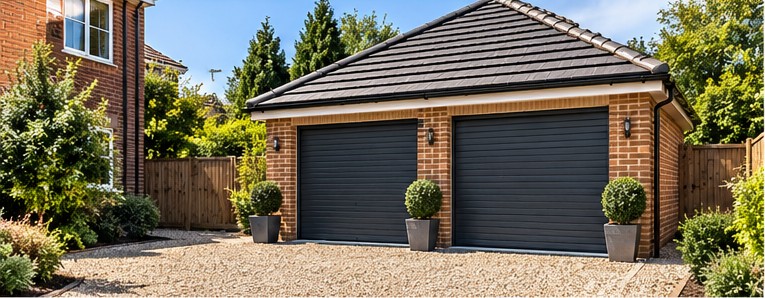
Secure parking or useful storage, single or double.
£350
Significantly more living space across both floors.
£1,400
A bright, glazed room connecting your home to the garden.
£900PERMITTED HOMEOWNER GUIDES
Our illustrated, practical guides help you understand the rules, explore design options and budget with confidence — before you commit to building work.
Explore all guidesRules, design options, costs and next steps.
View guideRules, design options, costs and next steps.
View guideRules, design options, costs and next steps.
View guideRules, design options, costs and next steps.
View guideRules, design options, costs and next steps.
View guideRules, design options, costs and next steps.
View guideRules, design options, costs and next steps.
View guideRules, design options, costs and next steps.
View guideWe use cookies that are needed to run the basket and checkout. We would also like to use analytics cookies to understand how the site is used. We only do that if you say yes.

Maximize your property’s footprint with precision and ease. Permitted provides complete design for Permitted Development Rights. Our packages are designed around the Permitted Development limits, so many projects can proceed without a full planning application.
PERMITTED is operated by Yorkshire Property Design Services Limited, registered in England and Wales under company number 12698267.
Registered office: Ground Floor, Techno Centre, Station Road, Horsforth, Leeds, LS18 5BJ
Business contact address: Wira House, Ground Floor, Suite 5, Ring Road, West Park, Leeds, LS16 6EB